
Is your neighbor’s heat pump too loud? Measuring noise and knowing your rights
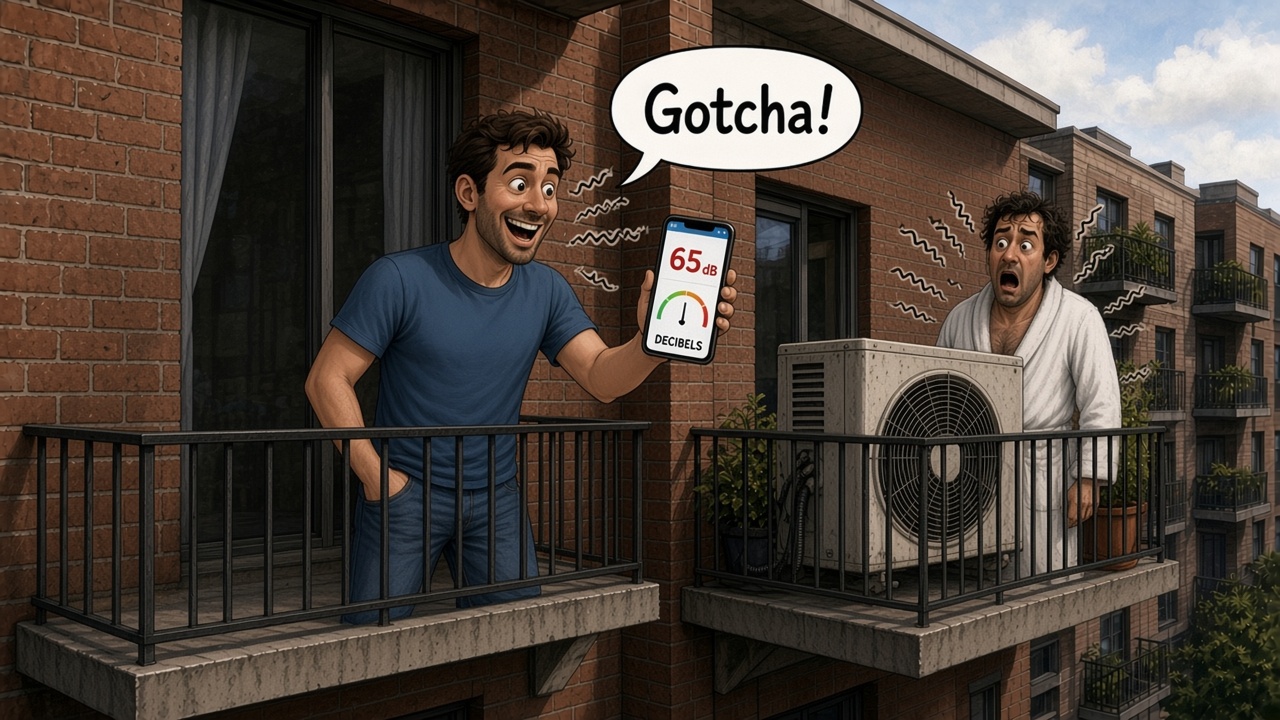
Heat pump outdoor units can run day and night, all year. That makes them a natural source of noise disputes between neighbors. If someone near you installs one, at 3920 or anywhere else, it helps to know what “too loud” means, how it is measured, and what has worked for people who complained.
This is general information, not legal or engineering advice. Rules differ by city, town, and condo, and your situation may differ. Talk to a qualified professional before relying on any of it.
Is it too loud?
Start with the honest question. Some sound from outdoor equipment is a normal part of living near other people. The law generally does not protect against every annoyance. It protects against interference that is substantial and unreasonable, judged by how a person of ordinary sensitivity would react, not the most sensitive person on the street.
Signs that you may be past ordinary annoyance: the sound wakes you at night, you can hear or feel it inside with the windows closed, it has a steady hum or whine you cannot tune out, it happens day after day, and it is noticeably louder than the street was before the unit went in.
What is “too loud,” and how is it measured?
The Massachusetts standard
Massachusetts treats noise as a form of air pollution under the state air regulations, 310 CMR 7.10. The MassDEP Noise Policy (DAQC Policy 90-001) says a source of sound is considered to violate the regulation if it either:
- raises the broadband sound level by more than 10 dBA above ambient, or
- produces a “pure tone” condition, meaning one octave band is 3 decibels or more louder than both neighboring bands. In plain English: a distinct hum or whine.
Both are measured at the property line and at the nearest inhabited residence. “Ambient” means the background level exceeded 90% of the time (called L90), measured during the hours the equipment runs. In March 2026 MassDEP released a discussion document proposing revisions to the 1990 policy, including a possible 40 dBA floor for very quiet areas, so check the current version before relying on the numbers.
Local limits
Cities and towns can add their own rules. Cambridge limits HVAC units to 50 dB(A) from 6 p.m. to 7 a.m. and 60 dB(A) during the day at the neighbor’s property line, and warns that many residents learn after installation that their unit is in violation. Boston treats anything louder than 50 decibels from 11 p.m. to 7 a.m. as unreasonable. Brookline’s bylaw treats a 10 dBA rise over background as noise pollution, or just 5 dBA if the sound is tonal. Other towns have their own codes, so look yours up.
How a proper measurement is done
- The meter. Professionals use a sound level meter that meets ANSI S1.4 or IEC 61672. Class 1 (Type 1) is precision grade; Class 2 is general purpose. A phone app is fine for a rough sense of things, but it is not evidence an inspector will rely on.
- A-weighting (dBA). Readings are usually A-weighted to match how the human ear hears. A-weighting downplays low frequencies, which is why a low hum can be more bothersome than its dBA number suggests. That is part of why the pure-tone test exists.
- Calibration. The meter is checked with an acoustic calibrator before and after measuring.
- Setup. The meter goes on a tripod, away from walls and your body, with a windscreen, at the property line or outside the affected window.
- Two readings. A background reading (L90) with the unit off, or during the quietest hours, and a reading with the unit running. The difference is what matters under the state policy.
Who measures
Your local board of health is usually the first stop. Local officials can enforce the state noise regulation. MassDEP regional offices handle noise complaints too. For a serious dispute, a private acoustical consultant can do a formal study, including an octave-band analysis for tonal noise.
Keep a dated log
Write down the date, time, how long it ran, the weather, where you were, what you heard or felt, and how it affected you. Note any readings. A log kept over weeks carries far more weight than one bad night.
Why heat pumps are especially prone to disputes
- The noisy part is outside. The compressor and fan sit in the outdoor unit, often next to a neighbor’s wall, window, or balcony.
- They run all year. An air conditioner runs in summer. A heat pump also heats, so it runs on winter nights, when background noise is lowest and people are sleeping.
- Defrost cycles. In cold weather the unit periodically reverses to melt ice, which can bring hissing, whooshing, and clunks at odd hours.
- Low-frequency, tonal hum. Compressors make a steady low tone that travels through walls and is hard to block.
- Vibration. Units on wall brackets or balconies can pass vibration into the building structure, which is a particular problem in condos with shared walls and slabs.
- Placement. Installers often choose the easiest spot for the installer, not the quietest spot for the neighbors, such as right under a bedroom window.
- Long run times. Inverter units are efficient because they run longer at lower speed. Quieter per minute, but many more minutes.
- Aging parts. Worn fan bearings, loose panels, and failing mounts get louder over time.
Put together, that makes heat pump noise a prime area for complaints, and sometimes lawsuits.
If your neighbor installs one: steps to advocate for yourself
- Log it. Start the dated log right away.
- Talk first. A calm conversation can lead to a quick fix: vibration pads, a different bracket, a quieter fan setting, a sound barrier, or moving the unit.
- Use the condo documents. Most master deeds, bylaws, and rules have a nuisance or noise clause. Write to the board and managing agent, cite the clause, and attach your log. Ask whether the installation was approved and on what conditions.
- File with the board of health. Ask for an inspection and measurement under 310 CMR 7.10 and your local ordinance. You can also contact MassDEP.
- Get a measurement. If officials will not measure, consider an acoustical consultant.
- Try mediation. Community mediation programs in Massachusetts are inexpensive and often faster than court.
- Small claims or court. Small claims can award money but not order the unit moved or shut off. A private nuisance case in District or Superior Court can seek an injunction. Talk to a lawyer before going this route.
One note: the Massachusetts Commission Against Discrimination handles discrimination, not noise, so it is not the place for a heat pump complaint.
The goal is not to stop anyone from heating their home. It is to make sure equipment is placed, mounted, and maintained so it does not take away a neighbor’s sleep.
How to sue your neighbor over heat pump noise (at 3920 Mystic Valley Parkway or anywhere else)
If a neighbor’s heat pump at 3920 Mystic Valley Parkway in Medford, or anywhere else, is keeping you up, a lawsuit is the last step, not the first. Here is how it generally works in Massachusetts. This is not a report of any problem at any address, and it is not legal advice.
- Know the legal theory. The usual claim is private nuisance: noise that substantially and unreasonably interferes with your use and enjoyment of your home. In a condominium, every unit owner must also comply with the master deed, bylaws, and rules (G.L. c. 183A, § 4(3)), and the trust can charge an owner for costs it incurs because of a violation (G.L. c. 183A, § 6(a)(ii)). So ask the trustees in writing to enforce the rules before you sue.
- Build evidence. Keep a dated log (time, duration, where you heard it, how it affected sleep). Make recordings. Ask the board of health or hire an acoustical consultant for meter readings; a rise of more than 10 dBA over ambient is the MassDEP benchmark described above. Get statements from witnesses and any doctor’s note about sleep problems.
- Send a demand letter first. Describe the problem, attach your evidence, propose fixes, and set a reasonable deadline. In a condo, send a written complaint to the trustees or managing agent asking them to enforce. Courts look for proof that you tried to solve it.
- Try mediation. Massachusetts community mediation centers handle neighbor noise disputes (find yours through Resolution Massachusetts). Courts also offer dispute resolution once a case is filed.
- Pick the right court. Small claims can award money only; it cannot order a unit moved or turned off. For Medford, the local court is Somerville District Court, which hears civil cases (civil complaint filing fee $195 including surcharge). For an injunction (an order to move, shield, or limit the hours of a unit), cases usually go to Superior Court; the Housing Court also hears cases about the use of residential property, and Medford is served by the Eastern Housing Court’s Middlesex Session, which sits Fridays at the Somerville courthouse.
- Know what you can ask for. Money damages, an injunction, relocation of the condenser, a sound barrier, or limits on night-time operation.
- Know whom to sue. Usually the owner who controls the unit. The condo trust may belong in the case if it approved the installation or refuses to enforce its rules. The installer is rarely the right defendant.
- Watch the clock. Tort claims generally must be filed within three years (G.L. c. 260, § 2A). Ongoing noise may be treated as a continuing nuisance, but don’t wait.
Tips to win
- Be reasonable and calm in every message; judges read them.
- Show you complained first and gave time to fix it.
- Use expert measurements, not just phone apps.
- Focus on night-time and bedroom impacts.
- Propose fixes: relocation, vibration pads, a compressor sound blanket, a barrier, or a quieter model.
Lawsuits are slow and expensive. Consider talking to a Massachusetts lawyer before you file.
Sources
- MassDEP Noise Policy, DAQC Policy 90-001
- MassDEP, Addressing Air Quality Nuisance Complaints (310 CMR 7.10)
- National Law Review: MassDEP proposes revisions to 1990 Noise Policy (2026)
- Cambridge License Commission HVAC noise guidance (PDF)
- City of Boston: Noise in Boston
- Brookline noise bylaw §8.15
- Boston Globe: heat pump as noisy neighbor (2025)
- VISOA: handling requests for heat pumps and air conditioners
- G.L. c. 183A, § 4 (unit owners must comply with bylaws, rules, master deed)
- G.L. c. 183A, § 6 (trust may assess costs of noncompliance)
- G.L. c. 260, § 2A (three-year limit for tort actions)
- Mass.gov: Small Claims Court
- Mass.gov: District Court filing fees
- Mass.gov: Courts serving Medford
- Mass.gov: Eastern Housing Court – Middlesex Session
- Resolution Massachusetts: community mediation centers
More: Heat pump noise: when a neighbor’s mini-split keeps you up · Heat pumps topic page
Caveat emptor.