
Heat pump noise: when a neighbor’s mini-split keeps you up
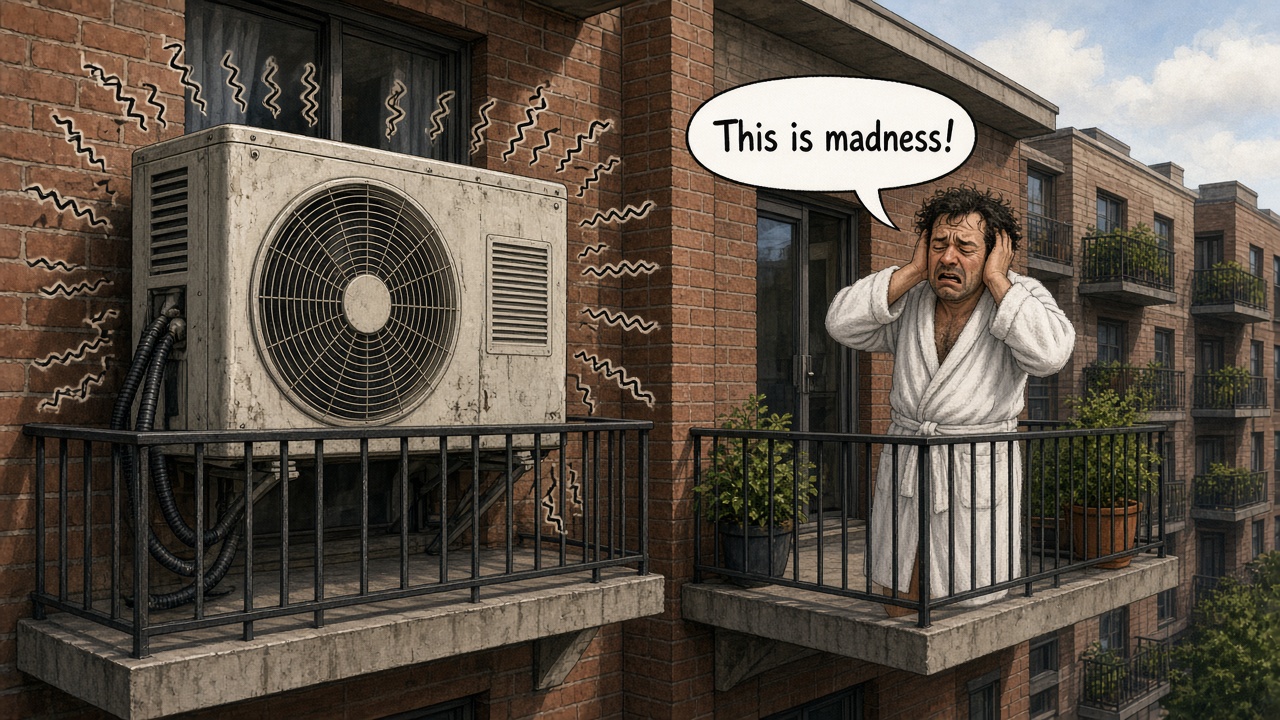
Split heat pumps (mini-splits) are quiet compared with old window units, but the outdoor condenser still has a compressor and a fan. In close quarters, like condos and tightly packed New England neighborhoods, that sound and vibration can become a real dispute.
This is general information, not legal or engineering advice. It applies to anyone living near outdoor HVAC equipment, and we are not describing any particular unit or building.
What the complaints sound like
The outdoor unit of a mini-split sits outside, often on a wall bracket, a pad, a roof, or a balcony. When it runs hard, on the coldest and hottest days, it runs longer. The complaints that reach newspapers and tribunals tend to be less about loudness than about a low, steady hum or vibration that is hard to escape, especially at night.
Two recent stories
Boston: “like a train or giant truck idling”
In a March 5, 2025 Ask the Remodeler column in the Boston Globe, a reader described a neighbor’s three Mitsubishi outdoor units that produce a low-frequency sound and vibration the reader compared to a train or a giant truck idling. The sound appeared to travel through the bedrock, and it was ruining the reader’s sleep. The columnist suggested vibration pads, quieter fan blades, and a sound-insulated roof over the units.
Toronto: a condo owner goes to the tribunal
In Gakman v. Toronto Standard Condominium Corporation No. 1957, 2026 ONCAT 33, a condo owner told Ontario’s Condominium Authority Tribunal that noise and vibration from heat pumps in a neighboring unit was substantially interfering with her quiet enjoyment of her unit, and that the condo corporation had failed to enforce its rules. The tribunal first considered dismissing the case because repair and maintenance disputes fall outside its jurisdiction. It let the case proceed because the heat pumps may be owned by individual unit owners rather than being common elements, while flagging that the named parties needed to be corrected. That is a procedural step, not a ruling on the noise.
A related case (air conditioner, not a heat pump)
In British Columbia, CBC reported that the Civil Resolution Tribunal awarded a Burnaby man $1,500 after he accused his strata council of failing to investigate his repeated complaints about the drone of a neighbor’s air conditioner. That case involved an AC unit, not a heat pump, but the equipment makes the same kind of sound.
Massachusetts noise limits
There is no single statewide decibel number for a neighbor’s condenser. Rules are local, and they differ:
- Cambridge. The License Commission’s HVAC noise guidance applies the city Noise Ordinance, §8.16.060(E): at the neighbor’s property line, a unit may not exceed 50 dB(A) between 6 p.m. and 7 a.m., or 60 dB(A) between 7 a.m. and 6 p.m. The guidance warns: “After installation, many residents learn their Unit is in violation of the Noise Ordinance.”
- Boston. The city’s noise page says anything louder than 50 decibels from 11 p.m. to 7 a.m., or louder than 70 decibels at any time (except permitted construction), is unreasonable. HVAC noise complaints go to the Boston Public Health Commission at 617-534-5965.
- Brookline. The town’s noise bylaw, §8.15, treats a noise source that raises levels 10 dBA or more above the background as noise pollution, or just 5 dBA if the sound is tonal, like a steady hum.
Other towns, including Medford, have their own rules. Check your city or town code before assuming a number.
Condo approval is not a free pass
In a condo, a board may approve a heat pump installation, but approval is not the end of the story. Guidance from the Vancouver Island Strata Owners Association (VISOA) on handling requests for heat pumps and air conditioners notes that heat pumps can create unreasonable noise, that a court has said running a heat pump at a particular level can amount to a nuisance, and that a heat pump is still subject to noise and nuisance bylaws even if it was installed before those bylaws were passed. Approval to install does not protect an owner from a nuisance complaint later. That guidance is from British Columbia, but the same tension between “approved” and “too loud” exists in any condo.
What you can do
- Document it. Keep a log of dates, times, how long it lasts, the weather, and how it affects you (for example, waking up at 2 a.m.). Patterns matter more than one bad night.
- Measure it, roughly. A sound meter app on your phone gives a rough reading, not official evidence. Note the reading, where you stood, and the time. Take a background reading when the unit is off too, since Brookline-style rules compare against background.
- Check your local rule. Look up your city or town noise ordinance and who enforces it. In Boston, that is the Public Health Commission; in Cambridge, the License Commission.
- Write to the board or manager. In a condo, put your complaint in writing to the board and managing agent, cite the condo rules on noise or nuisance, and attach your log. Keep copies.
- Ask about mitigation. Common fixes include vibration isolation pads or mounts, quieter fan blades, moving the unit away from bedrooms and shared walls, and sound enclosures or barriers. The Globe columnist suggested pads, quieter blades, and a sound-insulated roof.
Sources
- Boston Globe, Ask the Remodeler, Mar. 5, 2025
- Gakman v. TSCC No. 1957, 2026 ONCAT 33
- CBC News: noise complaint over air conditioner
- Cambridge License Commission: HVAC noise guidance (PDF)
- City of Boston: Noise in Boston
- Brookline General By-Laws §8.15, Noise Control
- VISOA: Handling requests for heat pumps and air conditioners